

The American workday looks quite different today than it did a few decades ago.
About 57% of wage and salary workers can change the time they start or finish work, equal to roughly 85.9 million employees.
You can work in an office five days a week and start at 7:30 when it suits you, or you can have a fully remote job with a required 9-to-5 shift. Flexible Start and Finish Times show how much control employees have over when their workday begins or ends.
How did America reach a point where most employees can move their workday at least occasionally? Let’s look at how it happened.
In this report
Where the 57% Figure Comes From
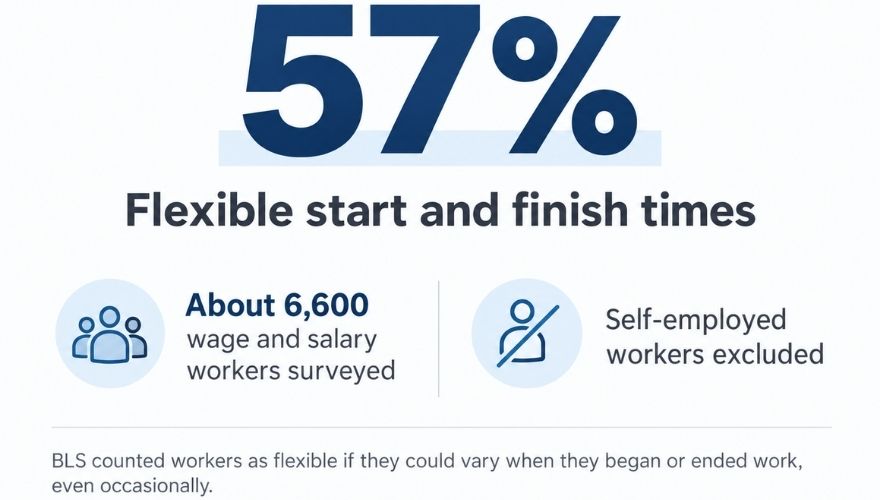
The 57% figure comes from the 2024–2025 Leave and Job Flexibilities Module of the American Time Use Survey, a federal survey conducted by the U.S. Census Bureau for the Bureau of Labor Statistics.
About 6,600 wage and salary workers answered questions about their main job, including how much control they had over their schedules and how far in advance they knew when they would work. Self-employed workers were excluded.
BLS counted a worker as having Flexible Start and Finish Times when they could vary the time they began or ended work, even if they could do so only occasionally.
How Did Employers Come Up With Flexible Work Hours?
Flextime is not actually an American invention. Some of the earliest widely used systems appeared in West Germany during the 1960s, where companies wanted to attract more workers and reduce congestion caused by thousands of employees arriving at the same time.
The model later reached American companies, but it took years before it became common.
The U.S. Bureau of Labor Statistics recorded Flexible Start and Finish Times for only 12.4% of full-time wage and salary workers in 1985. The share rose to 15% by 1991 and 27.6% by 1997. In 2004, it remained at 27.5%, with major differences across occupations.
Management, business and financial operations workers were already at 44.7% in 2004, compared with 12.4% in production occupations.
The historical series is not directly comparable with today’s ATUS measure, but it shows how much less common Flexible Start and Finish Times were among full-time workers several decades ago.
Why Flexible Hours Became Worth Keeping

Flexible hours are often presented as a benefit for employees, but companies had business reasons to keep them. Flexible Start and Finish Times can help employers recruit people who would struggle with a strict schedule because of family responsibilities. They can also make it easier to retain workers who need more control over when the day begins or ends.
Is There Evidence That Greater Schedule Control Makes a Difference?
Yes. A NIOSH study of U.S. workers found that the ability to change work schedules was associated with a 20% lower likelihood of job stress and a 60% higher likelihood of job satisfaction.
NIOSH economists Tapas Ray and Regina Pana-Cryan describe flexibility as a factor that gives workers a greater sense of control over their jobs. Their review of work flexibility and worker well-being also found an important limitation: working from home can increase job satisfaction, but it can also weaken the boundary between work and personal life.
Today, 85.9 Million People Can Change When They Start or Finish Work
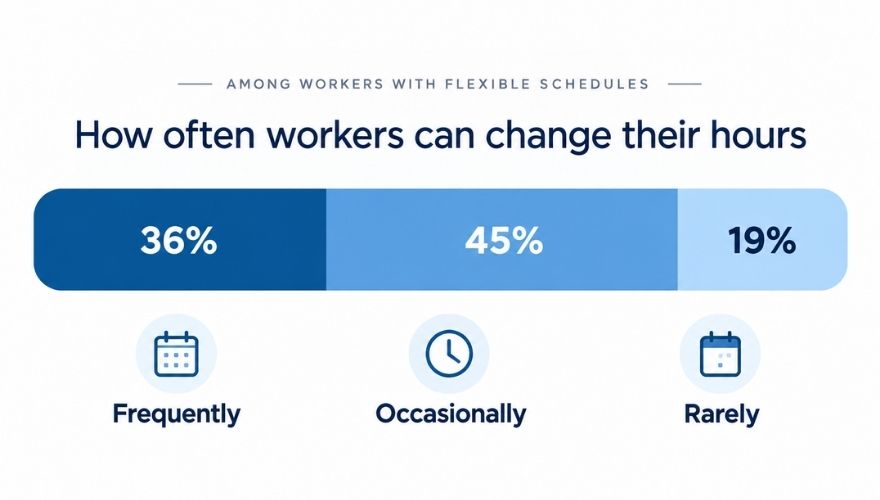
The headline figure hides a large difference in how often workers can actually use Flexible Start and Finish Times.
Only 36% of workers with flexible schedules say they can frequently change their hours. About 45% can do so occasionally, while the remaining 19% have that option only rarely.
An even more interesting difference appears between work hours and work location. According to the latest Bureau of Labor Statistics report, 78% of employees who can work from home also have Flexible Start and Finish Times. Among workers without a home-office option, the share is 44%.
Flexible Hours Affect Both Personal Life and the Economy

A flexible start to the workday first changes an employee’s personal schedule, but when tens of millions of people have the same option, the effects reach much further.
- Families can fit responsibilities around work more easily: parents may move their start time around school schedules or medical appointments without taking an entire day off.
- Less time can be lost in traffic: an employee who avoids the busiest part of rush hour may reduce commute time and spend more time at home.
- Stress may be lower: greater schedule control has been associated with higher job satisfaction and less pressure during the workday.
- Employers can reach a wider pool of workers: Flexible Start and Finish Times can make some jobs more workable for people with caregiving responsibilities.
- The direct tax effect is limited: unlike remote work, Flexible Start and Finish Times usually do not move an employee into another tax jurisdiction because the physical workplace stays the same.
If you are considering a job with Flexible Start and Finish Times, a few other questions may also be worth asking.
Do Flexible Hours Mean I Can Work Whenever I Want?
Usually not. Many companies have core hours when everyone must be available.
What Happens if I Have an Appointment in the Middle of the Day?
That depends on company policy. Some employers allow workers to make up the time later, while others require sick leave or PTO during core hours.
Can I Work Four 10-Hour Days and Take Friday Off?
Sometimes. A compressed workweek is a separate type of flexible arrangement in which the same weekly hours are worked across fewer days. It is different from simply changing daily start or finish times.
Does a Flexible Schedule Change Overtime Rights?
A flexible start time does not remove overtime rules. For covered nonexempt employees, the federal FLSA generally still requires at least 1.5 times the regular rate for hours worked beyond 40 in a workweek.
Can a Company Later Remove a Flexible Schedule?
In many cases, yes. Employment contracts, collective bargaining agreements, disability accommodations or state laws can affect what an employer may change.
Data and Methodology
Household Figures uses data from the U.S. Bureau of Labor Statistics report Job Flexibilities and Work Schedules 2024–2025, published on September 24, 2026. The estimates come from the American Time Use Survey and cover wage and salary workers in their main or only job.
The 2024–2025 supplement included about 6,600 wage and salary workers. Self-employed workers were excluded.
BLS defines a flexible schedule as the ability to vary start or finish times. Flexible Start and Finish Times therefore measure control over when the workday begins or ends, while working from home is measured separately.
Among workers with schedule flexibility, 36% could change their schedule frequently, 45% occasionally and 19% rarely.
Historical figures for 1985–2004 come from earlier BLS surveys with a different worker population, so they serve only as historical context rather than a directly continuous statistical series.
NIOSH estimates on stress and job satisfaction come from nationally representative Quality of Worklife data collected between 2002 and 2018. The results show statistical associations rather than proof that Flexible Start and Finish Times alone caused the reported differences.