

Large U.S. companies have brought employees back to offices more often in recent years, but national data shows that work from home still accounts for a large share of the American labor market.
About 51 million wage and salary employees worked from home at least occasionally during 2024 and 2025, equal to 33.6% of all wage and salary workers covered by new Bureau of Labor Statistics data. A broader group of 55.9 million employees, or 36.9%, had jobs that allowed them to work from home.
The figure comes from a new Bureau of Labor Statistics report, published on September 24, 2026, and is based on average data for 2024 and 2025.
Even more notable is how many employees actually use the option when they have it. Of roughly 56 million people whose jobs allow work from home, nearly 51 million actually used that option, which makes remote work an active part of the work schedule for the vast majority of eligible employees.
In this report
Remote Work Is Concentrated in Several Types of Jobs
The video posted by user “unrubble” breaks down 2024 remote work statistics in the USA, covering the latest trends, benefits, and tools shaping the shift to remote work.
Remote work in the United States is not evenly distributed across the labor market.
The table below shows where work from home has already become a standard part of the job and where it remains relatively rare.
For 42 Million People, an Entire Workday Sometimes Happens at Home
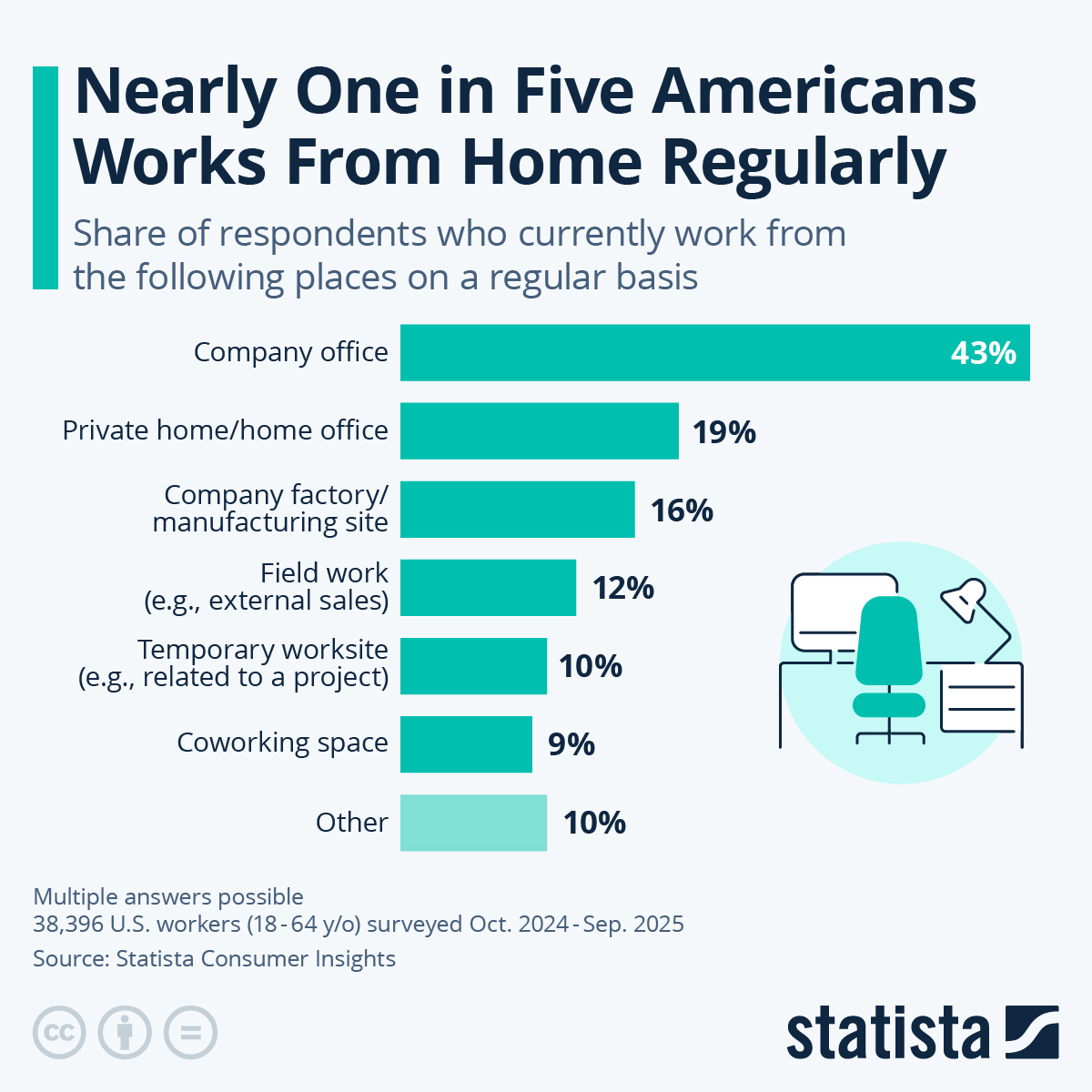 The 51 million figure includes anyone who works from home at least occasionally, so it does not mean all of those employees have fully remote jobs.
BLS provides another figure that shows how important home-based work has become within the workweek: about 42 million employees, or 28% of all wage and salary workers, had days when they worked exclusively from home. Among them, 87% had at least one such day per week, and more than one-third had five or more.
The reasons are split between job requirements and personal choice. According to BLS data on reasons for working from home, 32.7% of employees said their job required work from home, 31.3% cited personal preference, 11.8% cited coordination between work and personal or family responsibilities, and 10% cited reduced commute time or cost.
A College Degree Turns Out to Change the Odds of Working From Home
Among employees age 25 and older with a bachelor’s degree or higher, 57.1% work from home at least part of the time. Among people with a high school diploma and no college education, the share is about 15%, so education and occupation together create one of the clearest divides in the U.S. labor market.
The difference also appears in control over time. BLS says that 57% of all wage and salary workers have a flexible schedule that allows them to change the start or end of the workday, but such flexibility is far more common among people who have access to work from home.
Fewer People in Offices Have Changed the Economics of American Downtowns

Work from home has also changed where employees spend their money. When thousands of people stay away from business districts several days per week, less money reaches restaurants, coffee shops, parking garages and stores that relied for decades on a daily flow of office workers.
The largest direct impact appears in commercial real estate. Research by Arpit Gupta, Vrinda Mittal and Stijn Van Nieuwerburgh published through NBER, which also received a version in the American Economic Review in 2026, documents major changes in rents, occupancy, lease renewals and office building values. Their model for New York estimated a long-term 39% decline in office stock values, with consequences for local public finances and the financial sector.
Lower commercial property values can weaken a city’s tax base, and lower business activity in office districts changes revenue for a wide range of local companies.
American Society Is Losing Part of a Place Where People Used to Meet
For decades, the office also served as a social space, so fewer shared workdays affect the way people form relationships.
A SHRM survey from February 2026 found that 47% of U.S. employees are currently in a romantic relationship with a coworker or have had such a relationship in the past. Among people with remote or hybrid schedules, 39% say that type of work makes it harder to meet potential partners, although 37% disagree.
The figure matters because workplace relationships are far from rare. SHRM reported a year earlier that 52% of respondents had been or were currently involved in a workplace romance, and 16% of employees said they had gone on a date with a coworker during the previous year.
Less physical contact can therefore remove some of the spontaneous opportunities that arise when the same people see each other five days per week. The data still does not support a simple conclusion that remote work automatically leads to fewer relationships, because people meet partners outside the workplace as well, and hybrid schedules still preserve physical contact with coworkers.
51 Million Employees Show How Much American Work Has Changed

Work from home has declined from its pandemic peak, but it has settled far above 2019 levels. Hybrid schedules now occupy a central place among jobs that can be performed remotely, and new BLS data shows that home remains part of the workplace for roughly one-third of U.S. wage and salary workers.
Flexible working hours have also become increasingly important, allowing employees to better balance their professional responsibilities with personal commitments.
The effects extend far beyond employee schedules. Office buildings carry different values, local tax bases can shift, employees can move more easily between cities or states, and part of the social life that once formed automatically around the office now takes a different shape.
Even fertility has become part of the new economic literature on remote work, with preliminary results that suggest flexibility among couples may be associated with a higher number of planned and realized births.
The 51 million figure therefore points to a much larger change than the location of a laptop. It shows how the links between work, home, cities, taxes and family life have changed across the United States.
Data and Methodology
Household Figures uses data from Job Flexibilities and Work Schedules – 2024-2025, a report published by the Bureau of Labor Statistics on September 24, 2026. The data represents averages for 2024 and 2025 and covers wage and salary workers and their main or only job.
The main estimate of 50.9 million includes employees who said they actually work from home at least occasionally. The figure therefore does not represent the number of fully remote jobs, but a broader group of employees for whom home serves as a workplace at least some of the time.
For broader economic and social context, Household Figures uses Census Bureau research on migration, Gallup data on hybrid work, SHRM research on workplace relationships, and NBER papers on commercial real estate and fertility. Different remote-work measures are not treated as interchangeable.
References
- S. Bureau of Labor Statistics – Job Flexibilities and Work Schedules, 2024–2025
- S. Bureau of Labor Statistics – Workers Who Could and Did Work at Home
- S. Bureau of Labor Statistics – Main Reasons Workers Worked at Home
- Gallup – Hybrid Work
- Federal Reserve Bank of Minneapolis – Is Remote Work Declining?
- S. Census Bureau – Remote Work and Residential Sorting
- NBER – Work From Home and the Office Real Estate Apocalypse
- NBER – Work From Home and Fertility
- SHRM – 2026 Workplace Romance Research