

California has the two U.S. metropolitan areas with the highest shares of young adults who live in their parents’ homes. Both are well above the national average.
About 33% of adults ages 25 to 34 in Vallejo and the Oxnard–Thousand Oaks–Ventura metro area lived in a parent’s home in 2023. The national figure was 18%, according to a Pew Research Center analysis of U.S. Census Bureau data published in April 2025.
Oxnard’s figure was approximately 32.8% before rounding, compared with 33% in Vallejo. El Centro, another California metro area, followed closely at 32%.
Housing affordability is one possible explanation, particularly around Oxnard. Yet the research also points to an important complication: high rents alone cannot explain why so many young adults live with their parents.
In this report
Vallejo and Oxnard are far above the national average

Pew examined adults ages 25 to 34 across 258 U.S. metropolitan areas with sufficient data for comparison. The analysis covered metro areas that collectively accounted for 81% of Americans in that age group.
Vallejo and Oxnard occupied the top two positions. Several other California metro areas also reported relatively high shares.
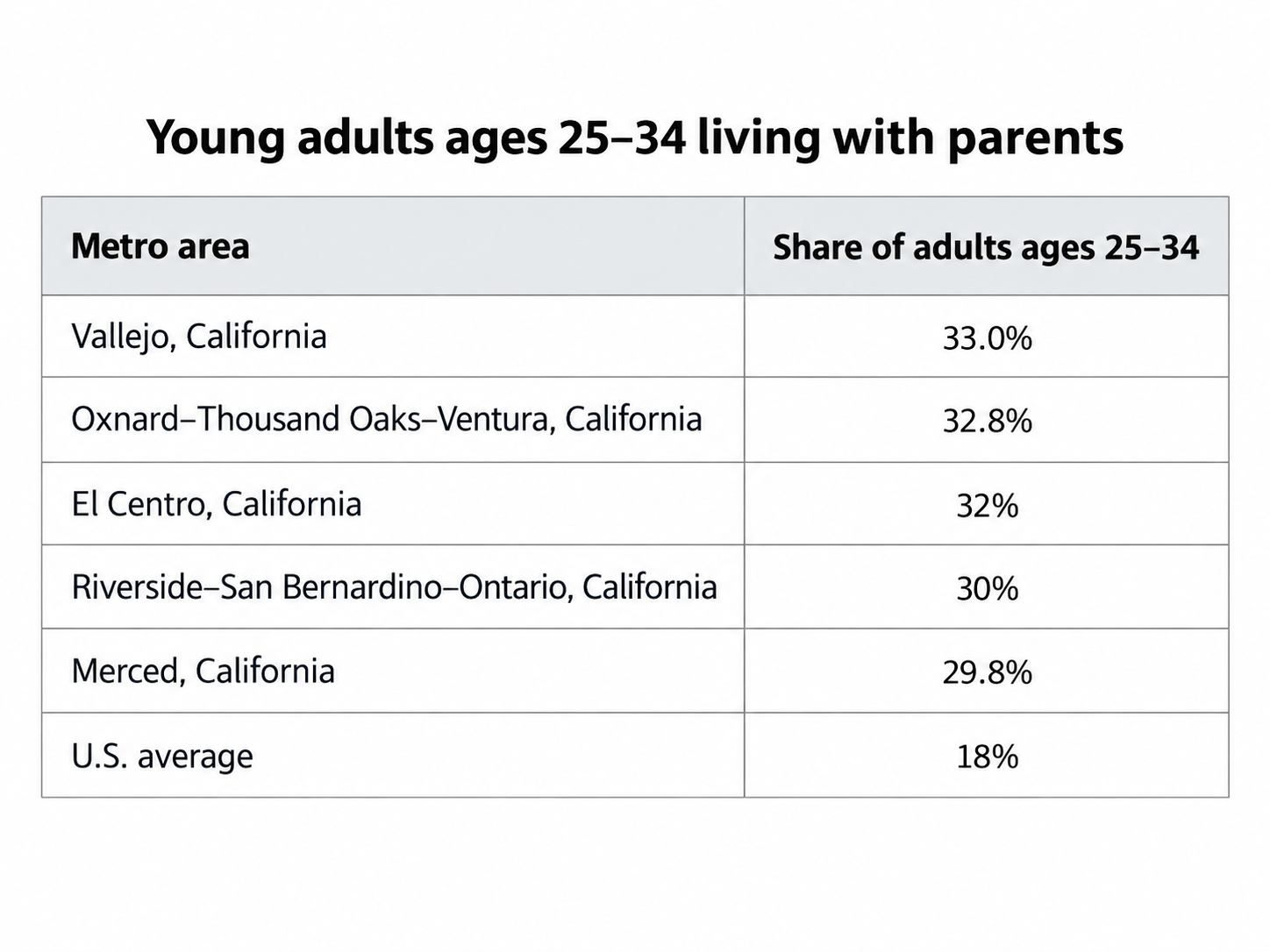
Source: Pew Research Center’s April 2025 analysis of Census Bureau data. Figures below whole percentages reflect additional precision reported in published accounts of the analysis.
The difference between the leading metro areas and the national average is substantial.
Using the rounded Pew figures, the share of young adults living with parents in Vallejo and Oxnard was approximately 1.83 times the national rate. That represents a gap of 15 percentage points, or roughly 83% above the U.S. average.
The distinction between percentage points and relative percentages matters. A 15-percentage-point gap represents a much larger proportional difference when the national baseline is 18%.
Pew also found a wide geographic spread. At the opposite end of its metro comparison, Odessa, Texas, and several other communities recorded shares of approximately 3%.
The national average therefore conceals considerable differences between local housing and household arrangements.
Housing costs put particular pressure on young adults around Oxnard
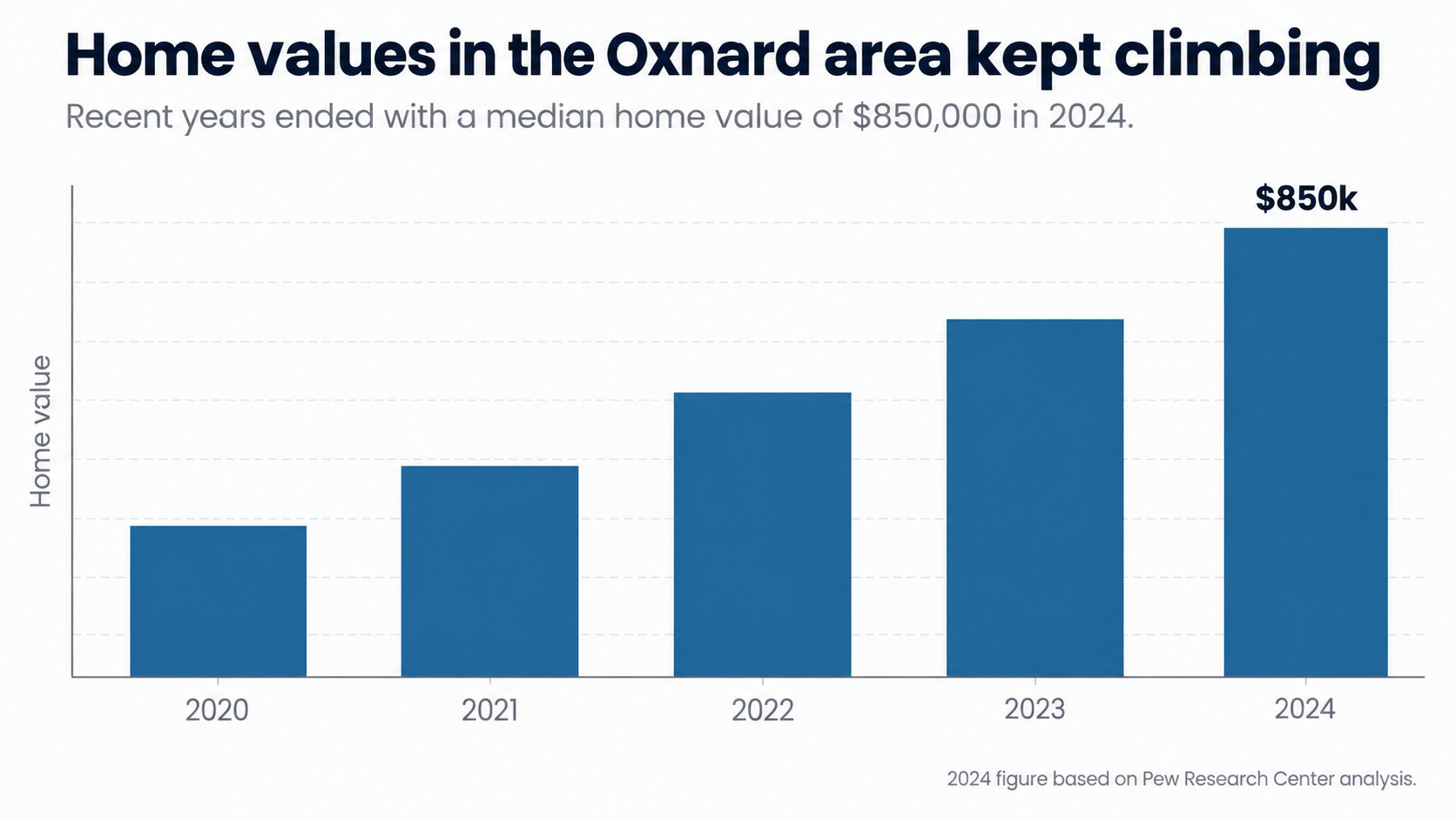
California’s housing market gives young adults a substantial financial reason to consider remaining in a family home.
A separate Pew housing affordability analysis, published in June 2026, placed Oxnard–Thousand Oaks–Ventura among the ten least affordable U.S. metropolitan areas for households headed by adults under 40.
The area’s home value-to-income ratio reached 7.1 in 2024.
Pew reported a median home value of $850,000 and median household income of $120,000 for younger households, adjusted for household size. Dividing the two figures produces a ratio of approximately 7.1.
For comparison, the national price-to-income ratio among younger households was 3.5 in 2024.
Oxnard’s ratio was therefore more than twice the national figure. The comparison offers a concrete measure of the area’s relatively expensive homeownership market.
It also requires an important qualification.
A price-to-income ratio measures the relationship between home values and household income. It does not measure the share of income spent on rent. It cannot establish how many young adults remain with their parents because they cannot afford their own homes.
Pew’s 2023 metro analysis actually found no consistent association between median rents and the share of young adults living with parents across the 258 metro areas.
That result deserves attention. Expensive housing can influence individual household decisions without producing a consistent relationship across every metropolitan area. Other local characteristics may affect the outcome.
The Oxnard figures establish a serious homeownership affordability problem. They do not establish that housing costs caused its unusually high share of young adults living at home.
A job no longer guarantees that a young person can move out

Employment matters, but a job alone may be insufficient to support an independent household in an expensive market.
A September 2026 research brief by Geoffrey T. Sanzenbacher of the Center for Retirement Research at Boston College examined the increase in adults ages 25 to 34 who reside with their parents.
The analysis used Current Population Survey data through 2025. It assessed economic conditions associated with changes in parental co-residence since 2007.
Higher rental costs and broader price inflation accounted for a substantial portion of the increase.
Economic variables explained slightly less than half of the increase among men and slightly more than half among women. The results also suggested that labor market conditions affected men more strongly.
The study therefore supports an economic explanation for part of the national trend. It leaves a substantial share attributable to factors outside the measured economic variables.
El Centro provides an example of the employment problem
El Centro illustrates how employment conditions can accompany a high rate of adults living in a parental home.
In 2023, 8.2% of El Centro residents ages 25 to 34 were unemployed, compared with 4.4% across the metro areas examined by Pew.
The gap was 3.8 percentage points. El Centro’s unemployment rate for that age group was approximately 1.86 times the overall rate across the analyzed metros.
A local unemployment rate that high can make independent household formation more difficult for affected residents. Unemployment reduces a person’s capacity to qualify for a lease or pay recurring housing expenses without support.
However, Pew found no strong relationship between local unemployment rates and parental co-residence across its full metro sample.
El Centro represents a documented local example rather than proof of a nationwide rule.
Later marriage is another possible factor
A 2024 study in Real Estate Economics by Arthur Acolin, Desen Lin, and Susan Wachter examined why young adults reside with parents.
The researchers examined adults ages 18 to 29 over the period 2000–2021. Their model accounted for the relationship between decisions about marriage or parenthood and household residence.
The study attributed approximately one-quarter of the nine-percentage-point increase in parental co-residence over that period to deteriorating housing affordability under its adjusted model.
Changes associated with marriage and parenthood accounted for an additional substantial portion of the observed increase.
The findings suggest that household formation depends on more than immediate housing costs. Marriage and parenthood affect the circumstances in which adults establish separate households.
The study covered a younger age group and an earlier period than Pew’s 2023 metro comparison. Its results provide useful context rather than a direct explanation of Vallejo’s or Oxnard’s figures.
One in three young adults says more about California than the phrase “failure to launch”

The 33% figure in Vallejo and Oxnard can easily become a story about delayed independence. The available evidence supports a more careful interpretation.
Pew’s research describes a household arrangement. It does not measure personal ambition or the financial independence of every adult who lives with a parent.
Some residents may remain at home to reduce expenses. Others may share family responsibilities or prefer a multigenerational household.
The distinction matters because the same residential arrangement can result from different circumstances.
The 2023 data also showed that young men were more likely than young women to live with a parent nationally, at 20% and 15%, respectively. That difference indicates that household arrangements vary across demographic groups as well as locations.
For California, the major unresolved question is how much local affordability contributes to the exceptionally high shares in Vallejo and Oxnard.
A useful future comparison would examine changes in parental co-residence alongside local rental affordability for the same age group over multiple years. It would also need to account for differences in population composition.
For now, the strongest conclusion is narrower.
Vallejo and Oxnard had the highest recorded shares among the metro areas Pew analyzed in 2023. High homeownership costs offer relevant economic context, particularly in Oxnard, but the available metro data cannot assign a single cause to either area’s position.
Data and methodology
Household Figures uses the Pew Research Center analysis published on April 17, 2025, as the principal source for metropolitan data on young adults who lived in a parent’s home.
Pew analyzed the 2023 American Community Survey and Census Bureau data through the Integrated Public Use Microdata Series (IPUMS) at the University of Minnesota.
The main measure represents adults ages 25 to 34 who lived in a household headed by their parent. Adults ages 18 to 24 were excluded because college dormitory residence can complicate comparisons of residential independence.
The analysis covered 258 metropolitan areas with adequate data. It excluded residents of smaller metro areas without sufficient data and people in nonmetropolitan areas.
The metropolitan percentages are survey-based estimates rather than complete counts of every eligible adult.
Pew reported Vallejo and Oxnard at approximately 33%. The Oxnard figure of 32.8% rounds to 33%, and El Centro’s reported share was 32%.
The percentage-point and relative comparisons in the article are calculations by Household Figures using the published percentages. Minor differences may arise if calculations use unrounded source estimates.
The affordability section relies on Pew’s June 24, 2026, report using 2024 American Community Survey data. The metro-level price-to-income ratio compares median home values with median income among households headed by adults younger than 40, adjusted for household size. That definition differs from the ages 25 to 34 used in the main residence analysis.
The economic explanation draws on Sanzenbacher’s September 22, 2026, research brief, which examines adults ages 25 to 34 using a different household survey.
The academic research by Acolin, Lin, and Wachter examines adults ages 18 to 29. Its estimates relate to national changes between 2000 and 2021.
The figures come from different populations and research periods. The affordability data and national research offer context for the metro comparison. They cannot independently determine the causes of parental co-residence in Vallejo or Oxnard.
References
- Pew Research Center – Young Adults and Parents — Richard Fry, April 17, 2025.
- Pew Research Center – Home Affordability — Richard Fry and Blen Wondimu, June 24, 2026.
- Center for Retirement Research – Parental Co-residence — Geoffrey T. Sanzenbacher, September 22, 2026.
- Real Estate Economics – Parental Co-residence Study — Arthur Acolin, Desen Lin, and Susan Wachter, 2024.